What does 3+1 mean? A plain guide for Plus Two students and parents
Degrees in Kerala are now four-year Honours programmes with an exit after three years. Here is what that means for your plans.
26 Oct 2026 · 3 min read
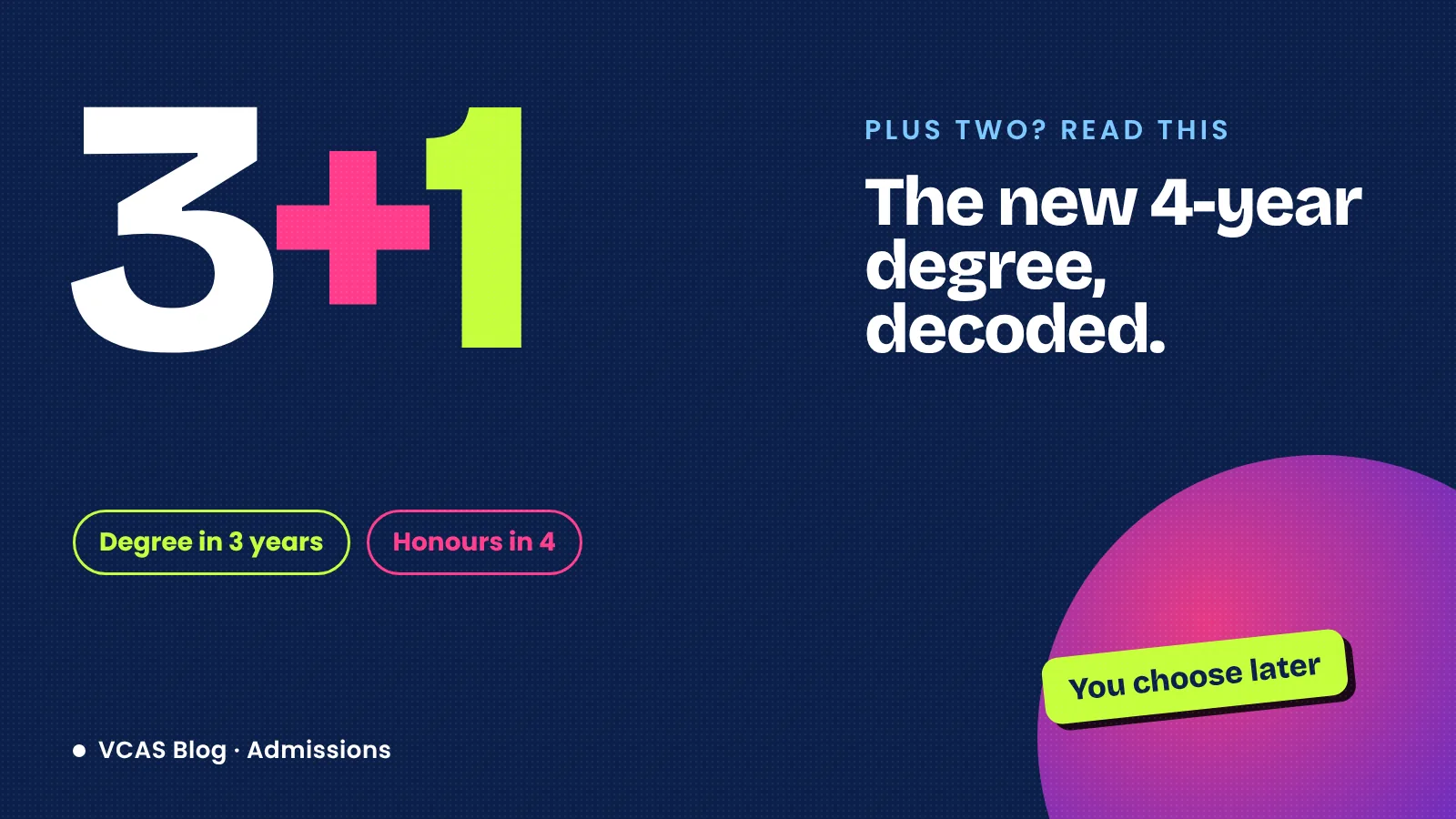
3+1 means you study three years for a regular degree, then may stay one more year for an Honours degree. You choose at the end of year three, not on day one.
If you have been reading college brochures this year, you have probably seen "3+1" or "4 years (Honours)" next to almost every course. Many parents ask us the same question at the admission desk: is the degree now four years long? The honest answer is: it can be, but it does not have to be.
Where 3+1 comes from
From 2024, universities in Kerala, including the University of Calicut, moved their undergraduate courses to the Four-Year Undergraduate Programme, usually shortened to FYUGP. It follows the National Education Policy, with some changes made by Kerala.
Every student joins a four-year programme. But Kerala allows one exit with a full degree after the third year. That is the "3". The optional fourth year is the "+1".
What you get after three years
If you leave after six semesters, you receive a regular bachelor's degree, such as BCA or B.Com. To earn it, you need at least 133 credits. A credit is simply a unit of study; each semester carries about 21 to 24 credits.
This three-year degree is a complete degree. You can use it to apply for jobs, for PG courses such as MBA, MCA or M.Com, and for government exams, just as graduates did before.
What the fourth year adds
Students who stay for the fourth year earn an Honours degree, with 177 credits in total. There are two routes:
- Honours: extra advanced courses in your main subject, with an optional project.
- Honours with Research: a compulsory research project worth 12 credits, where you study a problem in depth and present what you found.
The fourth year suits students who want deeper knowledge of one subject, plan to go abroad for higher studies, or are thinking about research and teaching careers.
Majors and minors
FYUGP also changes what you study each semester. Alongside your main subject, called the major, you take minor courses from other areas, plus common courses in languages and skills. In the first year these other courses can make up a large share of your timetable.
This is useful. A Cyber Security student who also studies some management, or a commerce student who learns some data analysis, leaves college with a broader set of skills.
Do you have to decide now?
No. You join the programme after Plus Two and decide about the fourth year at the end of the third. By then you will know your marks, your interests and your plans much better than you do today.
Questions families often ask us
Is the three-year degree worth less than before? No. It is still a full bachelor's degree from the University.
Can I do a PG course straight after year three? Yes. Most PG courses accept a three-year degree. Some universities also let Honours graduates finish a PG degree in one year, so check the rules of the course you want.
Does every course follow 3+1? At colleges affiliated to the University of Calicut, the Arts and Science programmes follow the FYUGP structure. All programmes at Vedavyasa College of Arts and Science are listed as 3+1.
Will the college help me choose? Yes. Your faculty advisor talks with you before you choose your minors and before the fourth year.
The short version
Think of 3+1 as a degree with a choice built in. Three years gives you a complete degree. One more year gives you an Honours degree with more depth or research. You do not have to choose on admission day.
If you still have questions about how this works for a particular course, our admissions team is happy to explain on a call.